

Cybersecurity compliance is not optional for most small businesses — it is a legal and contractual obligation that determines whether you can continue operating in regulated industries, accepting certain payment methods, or serving enterprise clients. Yet many small business owners find compliance frameworks confusing, overlapping, and difficult to prioritize.
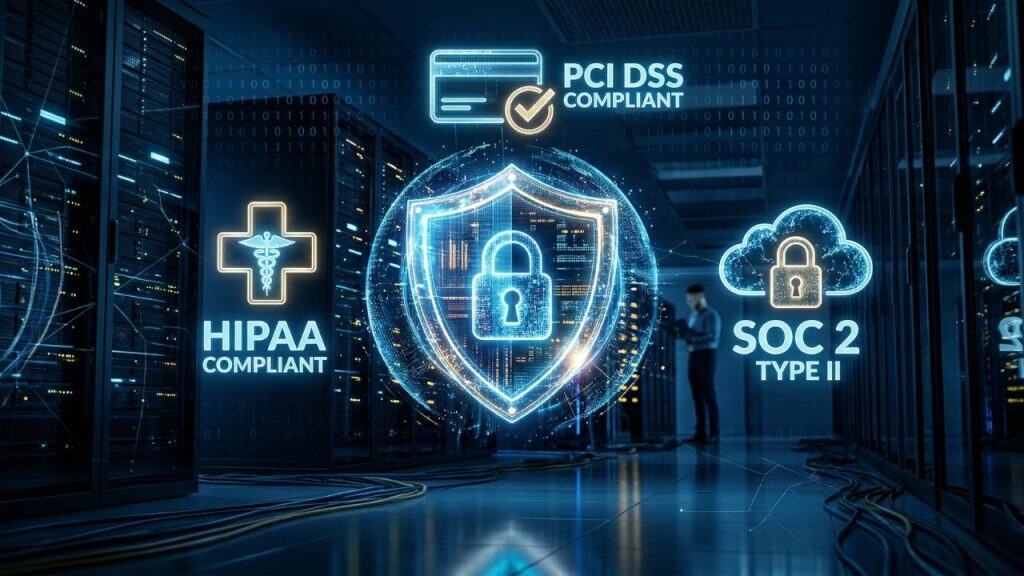
This guide demystifies the three compliance frameworks that most commonly affect small businesses — HIPAA, SOC 2, and PCI DSS — explains what each requires, and provides a practical roadmap for achieving and maintaining compliance.
Why Cybersecurity Compliance Matters for Small Businesses
Beyond legal and regulatory obligations, compliance frameworks serve a practical security purpose: they codify the minimum security controls that industry and government experts have determined are necessary to protect specific categories of sensitive data. A business that achieves genuine HIPAA, SOC 2, or PCI DSS compliance has, in the process, implemented a security posture that significantly reduces the likelihood and severity of cyberattacks.
Non-compliance carries three categories of risk: regulatory risk (fines, penalties, and enforcement actions), business risk (loss of ability to accept payments, serve regulated clients, or win enterprise contracts), and reputational risk (public breach disclosures, customer notification requirements, and lasting damage to customer trust).
HIPAA Compliance: Healthcare Data Security Requirements
Who HIPAA Applies To
HIPAA (Health Insurance Portability and Accountability Act) applies to Covered Entities — healthcare providers, health plans, and healthcare clearinghouses — and their Business Associates: any vendor or service provider that handles Protected Health Information (PHI) on behalf of a covered entity. Business Associates include IT service providers, cloud storage vendors, billing services, transcription companies, and any other third party that touches PHI.
Key HIPAA Security Rule Requirements
- Conduct and document an annual HIPAA Security Risk Assessment covering all systems that store, process, or transmit PHI.
- Implement access controls ensuring only authorized individuals can access PHI, including unique user IDs, automatic logoff, and audit logs.
- Encrypt PHI at rest and in transit using current encryption standards (AES-256 at rest, TLS 1.2+ in transit).
- Implement audit controls that record and examine access to PHI-containing systems.
- Establish a HIPAA-compliant Breach Notification policy and notify HHS and affected individuals within 60 days of discovering a breach affecting 500 or more individuals.
- Execute Business Associate Agreements (BAAs) with every vendor that handles PHI.
PCI DSS Compliance: Payment Card Data Security
Who PCI DSS Applies To
PCI DSS (Payment Card Industry Data Security Standard) applies to every organization that accepts, processes, stores, or transmits credit or debit card data. This includes retailers, restaurants, e-commerce businesses, healthcare providers, and professional services firms that accept card payments — regardless of company size or transaction volume.
PCI DSS Compliance Levels
| Merchant Level | Annual Transactions | Validation Requirement |
| Level 1 | 6M+ Visa/Mastercard transactions | Annual on-site QSA audit + quarterly network scan |
| Level 2 | 1M – 6M transactions | Annual Self-Assessment Questionnaire (SAQ) + quarterly scan |
| Level 3 | 20,000 – 1M e-commerce transactions | Annual SAQ + quarterly scan |
| Level 4 | Under 20,000 e-commerce / all others | Annual SAQ recommended + quarterly scan |
Most small businesses qualify as Level 4 merchants. The Self-Assessment Questionnaire (SAQ) appropriate for your situation depends on how you accept and process card data — whether through a third-party payment processor, a point-of-sale terminal, or a self-hosted e-commerce system.
SOC 2 Compliance: Trust Service Criteria for Cloud Services
What SOC 2 Is
SOC 2 (Service Organization Control 2) is an auditing framework developed by the American Institute of CPAs (AICPA) that evaluates how service organizations — particularly cloud-hosted software and IT service providers — manage and protect customer data. SOC 2 compliance is increasingly required by enterprise clients before they will purchase software or services that involve their data.
SOC 2 Trust Service Criteria
- Security: Systems are protected against unauthorized access, disclosure, and damage.
- Availability: Systems are available for operation as committed or agreed.
- Processing Integrity: System processing is complete, valid, accurate, timely, and authorized.
- Confidentiality: Information designated as confidential is protected.
- Privacy: Personal information is collected, used, retained, disclosed, and disposed of in conformity with privacy commitments.
Security is the only mandatory criterion. All others are included based on the specific commitments made to customers. A SOC 2 Type 1 report evaluates controls at a point in time. A SOC 2 Type 2 report — which enterprise clients typically require — evaluates the effectiveness of those controls over a period of 6 to 12 months.
Compliance Framework Comparison
| Framework | Who It Applies To | Key Focus | Audit Type | Penalty for Non-Compliance |
| HIPAA | Healthcare + Business Associates | PHI protection | HHS enforcement + third-party | Up to $1.9M/violation category |
| PCI DSS | All card-accepting businesses | Cardholder data security | QSA audit or SAQ | Card processing termination + fines |
| SOC 2 | Cloud service providers / SaaS | Customer data trust | CPA firm audit | Lost enterprise contracts |
| CMMC | DoD contractors / subcontractors | CUI protection | C3PAO assessment | Contract ineligibility |
| CCPA / CPRA | Businesses serving CA consumers | Consumer data rights | Self-attested + AG enforcement | Up to $7,500/intentional violation |
| FTC Safeguards Rule | Non-bank financial services | Customer financial data | FTC enforcement | Civil penalties + enforcement action |
| Expert Insight from PCRiver.com The compliance frameworks most SMBs face — HIPAA, PCI DSS, and SOC 2 — have extensive overlap with each other and with general cybersecurity best practices. A business that implements strong identity controls, endpoint protection, encryption, logging, and incident response simultaneously advances compliance across all three frameworks. Compliance and security are not separate initiatives — treat them as one program. |
Compliance Roadmap for Small Businesses
- Determine which frameworks apply to your business based on industry, data types, and client requirements.
- Conduct a gap assessment comparing your current security controls against the requirements of each applicable framework.
- Prioritize remediation by risk and compliance deadline. Start with the controls that close the most gaps across multiple frameworks simultaneously.
- Document everything. Compliance is not just about implementing controls — it is about demonstrating that controls exist and function as intended.
- Engage a qualified assessor. For HIPAA, a qualified privacy attorney or HIPAA consultant. For PCI DSS, a Qualified Security Assessor (QSA). For SOC 2, a licensed CPA firm.
- Implement continuous compliance monitoring to maintain your compliance posture between formal audits.
Frequently Asked Questions: Cybersecurity Compliance
Q: Can a small business be fined for HIPAA violations?
Yes. The HHS Office for Civil Rights (OCR) actively investigates and fines small healthcare providers and their business associates. HHS resolved 145 enforcement actions in FY2023. Fines range from $100 to $50,000 per violation, with annual caps by violation category up to $1.9 million. Many investigations are triggered by breach reports, employee complaints, or audits — not necessarily by patient complaints.
Q: Is PCI DSS compliance required for businesses that use PayPal or Square?
Businesses that process all payments through a fully hosted, third-party payment processor (such as PayPal Checkout, Square, or Stripe Checkout) where the business never touches card data have significantly reduced PCI DSS scope. However, some baseline requirements still apply, including completing an annual Self-Assessment Questionnaire (SAQ A), maintaining secure network configurations, and ensuring your website does not intercept card data. Check with your payment processor for your specific SAQ type.
Q: How long does SOC 2 Type 2 certification take?
A SOC 2 Type 2 audit requires a minimum observation period of six months during which your controls are in operation. Preparation — including gap assessment, control implementation, documentation, and readiness review — typically takes three to six months before the observation period begins. Total time from starting preparation to receiving a Type 2 report is typically 9 to 18 months. Compliance automation tools (such as Vanta, Drata, or Secureframe) can significantly accelerate this timeline.
Q: What happens if I process credit cards without PCI DSS compliance?
Non-compliance consequences escalate over time. Initially, card brands may impose monthly non-compliance fees ($10 to $100 per month) and require remediation. Following a breach, consequences become severe: fines of $5,000 to $100,000 per month, mandatory forensic investigation costs, breach notification costs, and potential termination of the ability to accept card payments. The total cost of a PCI-related breach typically far exceeds the cost of compliance.
Conclusion: Compliance Is a Business Investment, Not a Burden
Cybersecurity compliance frameworks are not bureaucratic burdens — they are structured roadmaps for implementing the security controls that protect your business and your customers. The cost of achieving and maintaining compliance is consistently lower than the cost of a single non-compliant breach.
| Next Steps PCRiver.com provides compliance-integrated managed IT services covering HIPAA, PCI DSS, SOC 2, and CMMC requirements. Contact us for a complimentary compliance gap assessment. |
Sources and References
- HHS HIPAA Enforcement Summary 2024 — hhs.gov/hipaa
- PCI Security Standards Council PCI DSS v4.0 — pcisecuritystandards.org
- AICPA SOC 2 Framework — aicpa.org
- FTC Safeguards Rule 2024 — ftc.gov
- CISA Compliance Resources — cisa.gov
| Quick Summary: Cybersecurity Compliance Frameworks |
| Cybersecurity compliance refers to the process of adhering to laws, regulations, and industry standards that define minimum security requirements for protecting specific types of sensitive data. |
| The three compliance frameworks most commonly affecting small businesses are HIPAA (healthcare data), PCI DSS (payment card data), and SOC 2 (cloud-hosted customer data). |
| HIPAA violations carry penalties of up to $1.9 million per violation category per year. PCI DSS non-compliance can result in loss of the ability to accept credit card payments. SOC 2 non-compliance limits enterprise sales opportunities. |
| Most compliance requirements overlap significantly with security best practices — implementing strong security controls simultaneously advances compliance across multiple frameworks. |
| Sources: HHS HIPAA Enforcement Data 2024, PCI Security Standards Council, AICPA SOC 2 Framework, FTC Safeguards Rule. |