
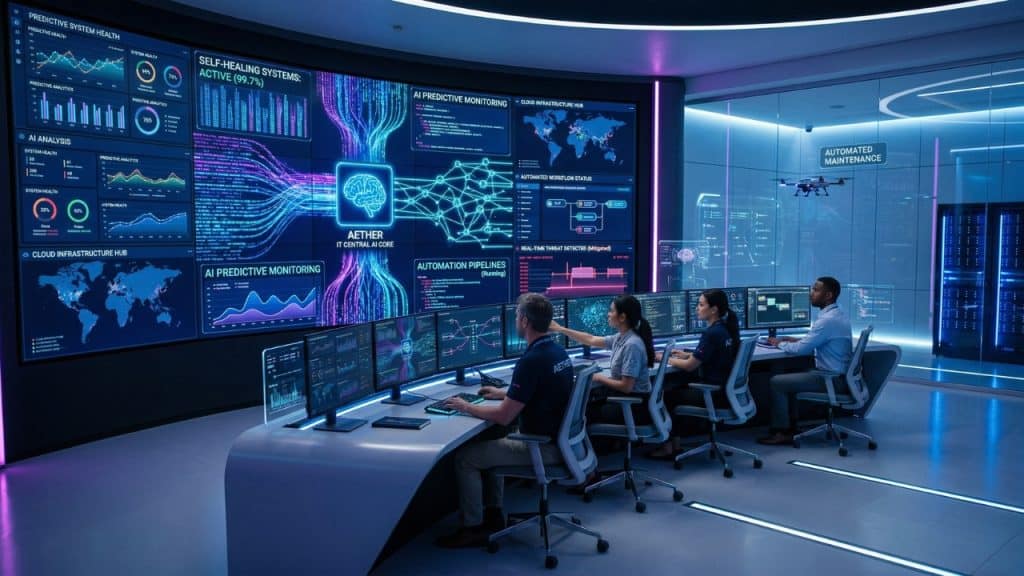

The IT support model has remained fundamentally unchanged for two decades: something breaks, a ticket is submitted, a technician investigates and resolves it. This reactive model is increasingly inadequate for businesses that depend on technology for every revenue-generating operation. The future of IT support — driven by AI, intelligent automation, and predictive analytics — replaces reaction with prevention.
This article examines the technologies reshaping IT support, what they mean for small businesses, and how to ensure your IT partner is positioned at the leading edge of this transformation rather than stuck in the break-fix past.
The Shift from Reactive to Predictive IT Support
The Problem with Reactive IT Support
Reactive IT support — responding to problems after they occur — is inherently expensive and disruptive. The cost of an IT issue compounds with every hour of downtime. By the time a ticket is submitted, triaged, assigned, diagnosed, and resolved, hours have passed. For businesses dependent on specific systems — a medical practice without access to its EHR, a retailer without its point-of-sale, a law firm without its document management system — those hours translate directly into lost revenue, frustrated customers, and stressed employees.
What Predictive IT Support Means
Predictive IT support uses machine learning models trained on millions of data points from server performance metrics, disk health statistics, network traffic patterns, error log frequencies, and historical incident data to identify the early warning signs of failure before the failure occurs. A predictive monitoring system might detect that a server’s memory utilization pattern matches the signature of systems that have failed within 72 hours and alert the IT team to replace it before the failure event. The problem is prevented, not repaired.
AI Technologies Transforming IT Support
AI-Powered Helpdesk Automation
AI chatbots and virtual agents now handle a significant percentage of helpdesk interactions autonomously. Modern AI helpdesk systems (built on large language models similar to Claude and GPT-4) can understand natural language support requests, diagnose common issues, execute automated resolutions (password resets, software installations, access provisioning, license assignments), and escalate to human technicians only when the issue exceeds their resolution capability. Response times drop from hours to seconds for automated-resolution issues.
Predictive Hardware Failure Detection
Machine learning models analyze SMART data from hard drives, thermal readings from servers, memory error rates, and power supply performance metrics to predict hardware failures before they occur. Google’s Site Reliability Engineering team published research demonstrating that ML models can predict hard drive failure with greater than 95% accuracy up to 72 hours in advance. This technology is now available in enterprise RMM platforms used by managed service providers.
Intelligent Security Operations
AI-driven security operations centers (SOCs) use machine learning to analyze security telemetry at a scale impossible for human analysts — processing billions of events per day, correlating patterns across thousands of endpoints simultaneously, and surfacing only the alerts that require human investigation. Platforms including Microsoft Sentinel, CrowdStrike Falcon, and SentinelOne use AI to reduce alert fatigue, prioritize genuine threats, and automate responses to detected incidents.
Natural Language IT Operations (AIOps)
AIOps (Artificial Intelligence for IT Operations) platforms apply machine learning to aggregate, analyze, and act on the vast volumes of data generated by modern IT environments — application performance metrics, infrastructure telemetry, security events, and business transaction data. AIOps identifies correlations between IT events and business outcomes, predicts performance degradation before it impacts users, and automates incident remediation based on learned resolution patterns.
IT Support Technology Evolution Timeline
| Era | Support Model | Detection Method | Resolution Method | SMB Impact |
| 2000-2010 | Break-Fix | User complaint | Manual repair | High downtime, unpredictable cost |
| 2010-2018 | Reactive Managed IT | Basic monitoring alerts | Remote + on-site support | Faster response, predictable cost |
| 2018-2023 | Proactive Managed IT | RMM monitoring + thresholds | Automated + human hybrid | Reduced downtime, security added |
| 2024-2026 | AI-Augmented IT | ML anomaly detection | AI-automated + human escalation | Near-real-time response, predictive |
| 2027+ | Predictive IT Operations | Predictive failure modeling | Preemptive remediation | Near-zero unplanned downtime |
What the Future of IT Support Means for Small Businesses
Faster Resolution at Lower Cost
As AI automation handles an increasing percentage of common IT issues autonomously, MSPs can resolve more issues with the same number of technicians — reducing the labor cost per incident and enabling faster response times for issues that do require human intervention. These efficiency gains translate to competitive pricing for SMB clients without sacrificing service quality.
Security Intelligence at SMB Scale
AI-powered security tools give small businesses access to threat intelligence, behavioral analysis, and automated response capabilities that previously required a dedicated enterprise security team. An AI-driven SOC that monitors a 25-person company’s environment with the same rigor previously applied only to Fortune 500 enterprises is not a future aspiration — it is available today through MSPs that have invested in modern security platforms.
Self-Healing IT Infrastructure
The most advanced future state of IT operations is self-healing infrastructure — systems that detect their own anomalies, diagnose the root cause, and execute remediation automatically without human involvement. Early self-healing capabilities are already available: automated failover for redundant systems, self-healing Kubernetes clusters in cloud environments, and automated patch deployment that targets specific vulnerability classes. This capability will expand significantly by 2027.
| Expert Insight from PCRiver.com When evaluating an MSP in 2026, ask two questions: What percentage of your incidents are resolved through automated remediation without human intervention? And what predictive analytics capabilities are you deploying in your RMM platform? An MSP that cannot answer both questions concretely is operating on a 2015 model in a 2026 environment. The gap between modern AI-augmented IT support and legacy reactive IT support is measured in your downtime, your security incidents, and your IT costs. |
How to Evaluate an MSP’s AI and Automation Capabilities
- Ask about their RMM platform: Modern RMM platforms (NinjaRMM, ConnectWise, Datto RMM, Kaseya) include AI-powered anomaly detection and automated remediation. If an MSP is using an older platform without ML capabilities, they are delivering reactive IT.
- Ask about their security operations: Do they operate or have access to an AI-driven SOC? What percentage of security alerts are automatically triaged vs. manually reviewed?
- Ask about predictive capabilities: Can they demonstrate predictive hardware failure detection? Do they proactively notify clients about impending failures, or do they wait for failures to occur?
- Ask about automation metrics: What percentage of helpdesk tickets are auto-resolved? What is their Mean Time to Resolution (MTTR) by ticket category? Declining MTTR over time is evidence of effective automation.
- Ask about their technology roadmap: An MSP without a stated plan for AI and automation adoption is not positioned to deliver next-generation IT support.
Frequently Asked Questions: Future of IT Support
Q: Will AI replace IT support professionals?
AI will not replace IT professionals — it will transform what they do. Routine, repetitive tasks (password resets, patch deployments, backup monitoring, alert triage) will increasingly be handled by AI automation. IT professionals will focus on higher-value work: complex problem-solving, architecture design, strategic advising, vendor management, and human-centered support for issues that require judgment, empathy, and creativity. The demand for IT professionals with strong problem-solving skills will grow even as demand for purely manual operational work declines.
Q: What is AIOps and how does it benefit small businesses?
AIOps (Artificial Intelligence for IT Operations) is the application of machine learning and data analytics to IT operations data to improve decision-making, automate remediation, and predict problems. For small businesses, the primary benefit of AIOps is delivered through their MSP: the MSP’s AIOps tools identify issues across all their managed clients simultaneously, prioritize the most critical alerts, and execute automated remediation — meaning problems at your business are addressed faster than any human-staffed monitoring operation could achieve.
Q: What is self-healing IT and when will it be available to SMBs?
Self-healing IT refers to systems that automatically detect, diagnose, and remediate their own failures without human intervention. Basic forms are available now: automated failover, self-healing cloud infrastructure, and automated patch deployment that targets specific vulnerability classes. More sophisticated self-healing capabilities — including AI-driven root cause analysis and automated multi-step remediation — are becoming available through leading MSP platforms in 2025-2026. SMBs that partner with technology-forward MSPs gain access to these capabilities as they are deployed.
Q: How does predictive monitoring work technically?
Predictive monitoring collects telemetry from managed systems — including CPU utilization patterns, memory error rates, disk performance statistics, network traffic anomalies, application response times, and error log frequencies. Machine learning models trained on large historical datasets identify patterns that precede failure events. When a monitored system’s telemetry matches a failure-precursor pattern, the system generates a predictive alert that allows IT teams to intervene before the failure occurs. The accuracy of predictive models improves over time as more data is collected and more failure events are observed.
Q: How should I prepare my business for AI-driven IT support?
Preparation involves three steps: ensuring your IT environment is well-documented and standardized (AI tools work best on environments where data is complete and consistent), selecting an MSP that has invested in AI and automation platforms rather than legacy manual processes, and establishing a technology roadmap that progressively adopts the self-healing and predictive capabilities as they become available. Businesses that operate on modern, cloud-ready infrastructure are best positioned to benefit from AI-driven IT support.
Conclusion: The IT Support Advantage Belongs to Businesses That Invest Now
The transformation of IT support from reactive repair to predictive prevention is not a distant future — it is the present. MSPs that have invested in AI-powered monitoring, intelligent automation, and predictive analytics are already delivering measurably better outcomes: less downtime, faster resolution, stronger security, and lower total cost of IT ownership.
Small businesses that partner with technology-forward MSPs gain the benefit of enterprise-grade AI capabilities delivered at SMB scale and price points. Those that remain with reactive break-fix providers or legacy MSPs operating without modern automation will pay the price in downtime, security incidents, and unnecessary IT costs.
| Next Steps PCRiver.com operates on a modern AI-augmented IT support platform delivering predictive monitoring, automated remediation, and AI-enhanced security operations. Contact us to understand how next-generation IT support compares to your current environment. |
Sources and References
- Gartner IT Service Management Predictions 2024 — gartner.com
- Forrester Future of IT Operations 2024 — forrester.com
- IDC AI in IT Management Report 2024 — idc.com
- Google SRE Hard Drive Failure Prediction Research — research.google
- Microsoft Azure AIOps Documentation — azure.microsoft.com
| Quick Summary: The Future of IT Support |
| IT support is undergoing the most significant transformation in its history, driven by artificial intelligence, intelligent automation, and predictive analytics that shift IT from reactive repair to proactive prevention. |
| By 2027, Gartner predicts that 40% of all IT support interactions will be resolved through AI-powered automation without human involvement — up from approximately 10% in 2023. |
| Predictive monitoring uses machine learning to analyze system telemetry and identify failure patterns before they cause downtime — enabling IT teams to fix problems that have not yet happened. |
| For SMBs, AI-driven IT support means faster resolution times, lower costs, fewer outages, and access to security intelligence that previously required large dedicated security teams. |
| Sources: Gartner IT Service Management Predictions 2024, Forrester Future of IT Operations 2024, IDC AI in IT Management Report 2024. |